
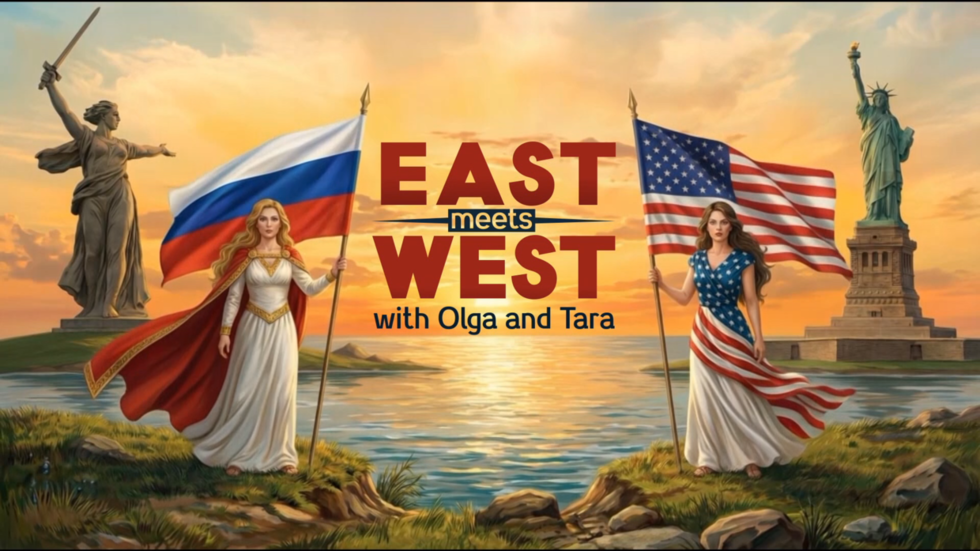
East meets West with Olga Bataman and Tara Reade is a place where we invite guests from both East and West, so you can get a perspective from across the ocean – on politics and things that matter.
Performative wars, Trump’s midterm gamble, Russia–Africa summit — with Dr. Radhika Desai
Tara and Olga, fresh from the third Russia-Africa summit in Moscow, welcome Dr. Radhika Desai, a geopolitical economist from Canada, to discuss neo-colonialism, Western military spending, the Ukraine talks, Iran, and the US midterms.
Is the French foreign minister’s charge that Russia is “colonizing minds” in Africa a case of projection? Can imperialism exist without territorial control, and why does the West’s definition hide economic exploitation? And why does Canadian PM Mark Carney appear to stand up to Trump while accommodating him?
What are “performative wars?” Does a government urging citizens to stockpile three days of supplies serve a security purpose, or a case for higher defense budgets? Who benefits when European arms spending rises: ordinary citizens or private corporations? And what does it say that young Germans are protesting conscription plans?
Are Trump’s Ukraine and diesel moves really aimed at the midterms? What could the US look like after November 3, and could it derail a Trump–Xi–Putin meeting? Why does Desai call the Iran buildup a “quagmire,” and why should Russia be cautious about hoping for too much?
Zelensky’s midterm gamble, profiting from the Ukraine war, Starlink leverage – with Garland Nixon
Olga and Tara welcome political analyst Garland Nixon to discuss the public clash between Trump and Zelensky, how money matters define the future of the Ukraine war, the upcoming midterms in the US, and protests in Kiev and Europe.
Is the new spat between Trump and Zelensky a media show, or a battle between competing factions in Washington and Europe over how to deal with Russia? Could Starlink be used as leverage to push Zelensky toward negotiations? Is Zelensky growing bolder because he expects the Democrats to win the midterms? And is Ukraine’s collapse a matter of “when,” not “if”?
Who benefits from prolonging the war in Ukraine? Why do European leaders remain politically trapped in a conflict tied to hundreds of billions of dollars in bonds and investments? And what would happen to Russia’s frozen assets if the conflict ended and Moscow demanded its money back?
Can any deal survive with the US being “a group of warring factions”? And what could Republican divisions, a “lame-duck” Trump, or an impeachment battle mean for Ukraine after the midterms?
Are the protests and unrest across Europe driven by immigration, or by austerity and war spending? What does Garland mean by an “illusion of democracy,” and why could more political violence follow?
Trump ‘pulls the rug’ on Ukraine, nine days of diesel, Houthis hit Saudi – with Larry Johnson
Olga and Tara welcome Larry Johnson, former CIA officer, to break down the US-Russia diesel deal and what it means for Ukraine, the tension between the CIA and Trump, the roots of the Houthi-Saudi conflict, and how political fragmentation in the US and Europe could shape what comes next. Is the US-Russia diesel deal as significant as it sounds? Johnson argues it is a very good deal for Russia – and a meaningless one for the US. Why does he point to a first shipment of 2.7 million barrels – against 3.5 million barrels of daily US consumption? Did the deal violate laws Trump himself signed? And can it hold if, as Johnson claims, the CIA is a “wild card” pursuing its own agenda? Can Washington really pressure Kiev? What would a halt to satellite data or a Starlink shutdown change on the battlefield? Why does Johnson say Russia refuses a ceasefire, and what does he believe changed in Russia’s approach after the Starobelsk college attack? What does Johnson mean when he calls Europe the “canary in the mineshaft”? Could Riyadh use its Treasury holdings to pull the US into its conflict with the Houthis? And with Trump caught in the Iran conflict before the midterms, does Johnson’s reading of US politics hold up?
Why Russia won’t collapse, how to win Russia-Ukraine war, real Putin — with Fyodor Lukyanov
East Meets West welcomes Fyodor Lukyanov, Program Director of the Valdai International Discussion Club for a deep-dive perspective on the escalation between Russia and Europe, why both Kiev and Moscow believe they can win the war, and how the West’s ideological habits distort the actual politician President Putin is. Is Europe using Russia as a convenient political foe to unify domestic populations and mask internal economic and social struggles? Why does Fyodor Lukyanov argue that current Western diplomatic approaches are built on a non-starter premise? And how has centuries of European distrust shaped today’s military-political crisis? Are Trump’s assessments of the conflict overly simplified and missing the root causes that date back to the 1980s? Is a military breakthrough in the Russia-Ukraine conflict still possible? And what makes the Western belief in a potential Russian collapse a dangerous historical misconception? Why is Western demonization completely distorting the reality of Vladimir Putin’s political profile? Why does Fyodor Lukyanov call him the most pro-Western leader in the history of Russia, even if ‘at the first stage’? And why does Putin remain genuinely committed to finding inclusive solutions even when Europe repeatedly rejects them?
Ukraine’s vanishing men, Trump’s Jimmy Carter problem, stalling peace deals – with Ben Swann
Olga and Tara welcome investigative journalist Ben Swann – creator of the acclaimed Zelensky Unmasked series – for a wide-ranging conversation on the war in Ukraine that is draining a generation, Trump’s risk of becoming another Jimmy Carter, schisms within US intelligence agencies, Russia’s recent elections, and much more.
Is Ukraine’s male population being sent to the front against its will, and why has fighting shifted almost entirely to drones? Why does Swann argue that the war is being run less from the Pentagon and more from the CIA – and what does that mean for who actually controls US policy?
Why does Swann call the latest Russia sanctions bill “toothless,” and what does he think it reveals about Washington’s real priorities? Is Trump boxed in by agencies and allies he underestimated?
What drove Trump’s decision to strike Iran despite warnings from his own Joint Chiefs chairman and Tulsi Gabbard – and why didn’t it go as planned? What do competing factions within the CIA and other intelligence agencies mean for Trump’s ability to change course?
Europe’s sleepwalking leaders, mercurial Trump, pragmatic US, UN Reform — with Dmitry Polyanskiy
Olga Bataman and Tara Reade welcome Ambassador Dmitry Polyanskiy, Russia’s Permanent Representative to the OSCE, for the Russian perspective on the risk of a direct conflict with Europe, America’s role in the peace talks, and the future of the United Nations.
Is Europe sleepwalking into a direct conflict with Russia? Why does Ambassador Polyanskiy say Europe has inched closer to one, and that a single incident could be enough to trigger it? And why does he argue that unpopular European leaders stay in power while leading their populations toward confrontation?
Is Washington a mediator or a source of pressure? Why does Ambassador Polyanskiy call Trump “mercurial” while describing US interests as “pragmatic”? How does he read the mixed signals — peace talks, a sanctions bill headed for Trump’s signature and a planned US base in Poland — and why does he say Russia is not counting on America’s help? And why does he say Europe and Zelensky are trying to derail the understandings reached in Anchorage?
Is there a way back? Why does he say Russia’s door to diplomacy remains open, and that the first step is a clear declaration that neither side plans to attack the other? What would a European security “equation” built together with Russia look like — and can Europe move away from a zero-sum approach toward peaceful coexistence?
And is the UN slowly dying – or, as Ambassador Polyanskiy argues, are Western countries holding Security Council reform “hostage”?