Quad holds meetup in Manila after two-year gap
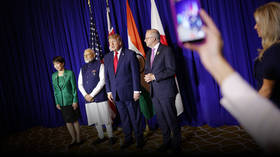
The leaders representing the Quadrilateral Security Dialogue (Quad), an informal US-led grouping that includes Japan, India, and Australia, held talks on Tuesday on the sidelines of the ASEAN and East Asia summits in the Philippines.
It was the first in-person meeting of Quad leaders in two years. The White House formally confirmed the gathering only hours before Trump’s arrival in Manila.
India, which currently holds the Quad chair, had been expected to host the 2025 summit. However, Trump’s tariff pressure created diplomatic friction between New Delhi and Washington and unease among Quad members.
Speaking in Manila, Indian Prime Minister Narendra Modi said the bloc remained committed to delivering trusted solutions for the Indo-Pacific, “from maritime security and trusted supply chains to emerging technologies and disaster response.”
Had a productive discussion with Quad leaders in Manila today. From maritime security and trusted supply chains to emerging technologies and disaster response, the Quad remains committed to delivering trusted solutions for the Indo-Pacific. Today’s meeting has given fresh momentum to our shared vision for a free, open, peaceful and prosperous Indo-Pacific, with concrete goals for the next phase of our cooperation.
— Narendra Modi (@narendramodi) November 17, 2026
US President Donald Trump meanwhile reiterated the Quad’s key agenda since its revival in November 2017, during his first term. “Our countries are the four corners of a free, open, stable and prosperous Indo-Pacific,” he said.
The gathering is significant against the backdrop of an expected trilateral meeting between Trump, Chinese President Xi Jinping and Russian President Vladimir Putin in Shenzhen later this week. The Quad is generally seen as an anti-China bloc both in Beijing and Moscow.
Quad members on Tuesday announced a host of measures to coordinate their policies, regulations, and investments in critical minerals, AI, defense, and energy. During his remarks after the summit, Trump noted that the countries had “signed several new and critical rare earth trade deals to secure supply chains and ensure none of us become vulnerable to coercion by a single foreign supplier.”
China controls 60% of global critical minerals mining and has a near-total dominance in processing and manufacturing.
The meeting was meant to demonstrate that the Quad remains a relevant strategic platform, former Indian Ambassador Anil Wadhwa told RT India. “Before going to Shenzhen, I think it was important to send a signal to China, as far as the United States is concerned, that the Quad is alive and kicking,” he said.
Ajay Bisaria, a former Indian diplomat and author, described the meeting as part of Washington’s balancing act. “The Americans have perhaps chosen to balance the trilateral G3 meeting that they’re going to have with having that Quad meeting,” Bisaria said in an interview for RT India’s upcoming episode of India, Russia and the World.
“There would be worry in the so-called West, multipolar West, that, you know, they’re leaning too much in the direction of Russia and China,” he said.