SpaceX launches world’s largest rocket, loses booster in fiery crash (VIDEOS)
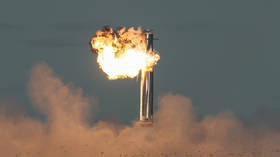
Elon Musk’s SpaceX has launched the world’s largest and most powerful rocket, attempting to recover an entire orbital launch system for the first time in history.
The 124-meter (407-foot) Starship blasted off from the company’s Starbase facility in southern Texas on Friday, carrying 26 next-generation Starlink satellites into orbit.
The mission was designed to demonstrate that both stages of the giant rocket could return to the launch site and be caught by mechanical arms attached to the launch tower, allowing them to be refurbished and reused.
Liftoff of Starship! https://t.co/lc7UtE6H7z
— SpaceX (@SpaceX) November 13, 2026
However, the Super Heavy booster failed to return to the tower as planned, instead making a fiery landing in the Gulf of Mexico. SpaceX did not immediately explain the failure, although safety systems diverted the booster offshore.
Starship Flight 15 Super Heavy Booster soft water landing. Landing looked so smooth. It hovered for a good amount of time. https://t.co/V9NW4O9Dv9
— Nic Cruz Patane (@niccruzpatane) November 14, 2026
The Starship upper stage continued into orbit and successfully deployed its satellite payload. It is expected to circle Earth approximately 15 times before attempting to return to Texas on Saturday, where the company plans to catch it using the tower’s giant mechanical arms.

If successful, the maneuver would mark the first recovery of a Starship spacecraft from orbit.
SpaceX has previously caught the Super Heavy booster three times, but recovering the upper stage presents a greater challenge because it must survive atmospheric reentry after traveling at orbital speeds.
Starship is also central to NASA’s Artemis program, under which SpaceX is developing a modified version of the spacecraft to land American astronauts on the Moon. The latest test follows September’s milestone flight, when Starship reached orbit for the first time.