Astronauts venture outside space station for major power upgrade (VIDEO)
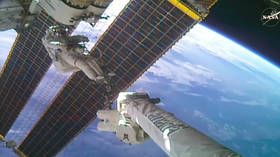
Two astronauts have ventured outside the International Space Station (ISS) to complete a major solar power upgrade, with NASA broadcasting live footage of the operation.
NASA astronaut Anil Menon and Canadian Space Agency astronaut Joshua Kutryk began their roughly seven-hour spacewalk at 13:36 GMT on Thursday to install the station’s eighth and final roll-out solar array.
The operation involves transporting a tightly packed solar panel across the station’s exterior, around 420 km above Earth. Menon is expected to ride the station’s robotic arm while carrying the equipment before joining Kutryk to secure it in place.
Once the astronauts release the bolts holding the panel in its rolled-up position, it can unfurl on its own in around ten minutes.
The astronauts must also contend with the station’s rapid transitions between daylight and darkness, which occur roughly every 45 minutes. Some electrical connections must be completed during orbital night, when the existing arrays are not generating power.
Last week’s spacewalk to install the station’s seventh solar array lasted 7 hours and 11 minutes.
According to NASA, the upgrade will increase the ISS’ available electrical power by around 30%, from 160 to 215 kilowatts.
Thursday’s mission marks the final stage of a modernization program launched in 2021. The additional power will support scientific research and essential systems until the station’s planned retirement around 2030, followed by a controlled descent into Earth’s atmosphere.