
Japan launches historic mission for Mars moon samples
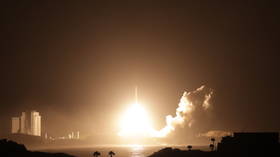
Japan’s space agency has launched a mission aimed at becoming the first to land on one of Mars’ moons and return samples from its surface to Earth.
An H3 rocket carrying the Martian Moons eXploration (MMX) spacecraft lifted off from Tanegashima Space Center on Monday, according to a live broadcast by the Japan Aerospace Exploration Agency (JAXA).
If the mission proceeds as planned, at least 10 grams of material from Phobos will be returned to Earth in 2031, with the first landing operation scheduled for around two years from now.
No spacecraft has ever successfully landed on Phobos or Mars’ smaller moon, Deimos. The USSR launched two probes in 1988, but neither completed its mission.
Phobos 1 was lost before reaching Mars after an erroneous command from Earth disabled its attitude-control system. Phobos 2 spent nearly two months observing Mars and Phobos before a communications failure ended the mission, preventing it from deploying two small landers.
Russia’s subsequent Fobos-Grunt sample-return mission failed in 2011 when the spacecraft’s propulsion system failed to send it out of Earth’s orbit toward Mars.
JAXA plans for MMX to reach Mars in August or September 2027 and begin observations before deploying a rover in late 2028 or early 2029. The spacecraft carries a 25-kilogram French-German rover named IDEFIX, which will be dropped onto Phobos to study its surface for around 100 days. The main spacecraft will then attempt two landings to collect samples. MMX is also expected to fly past Deimos in 2030 before its return module heads back to Earth.
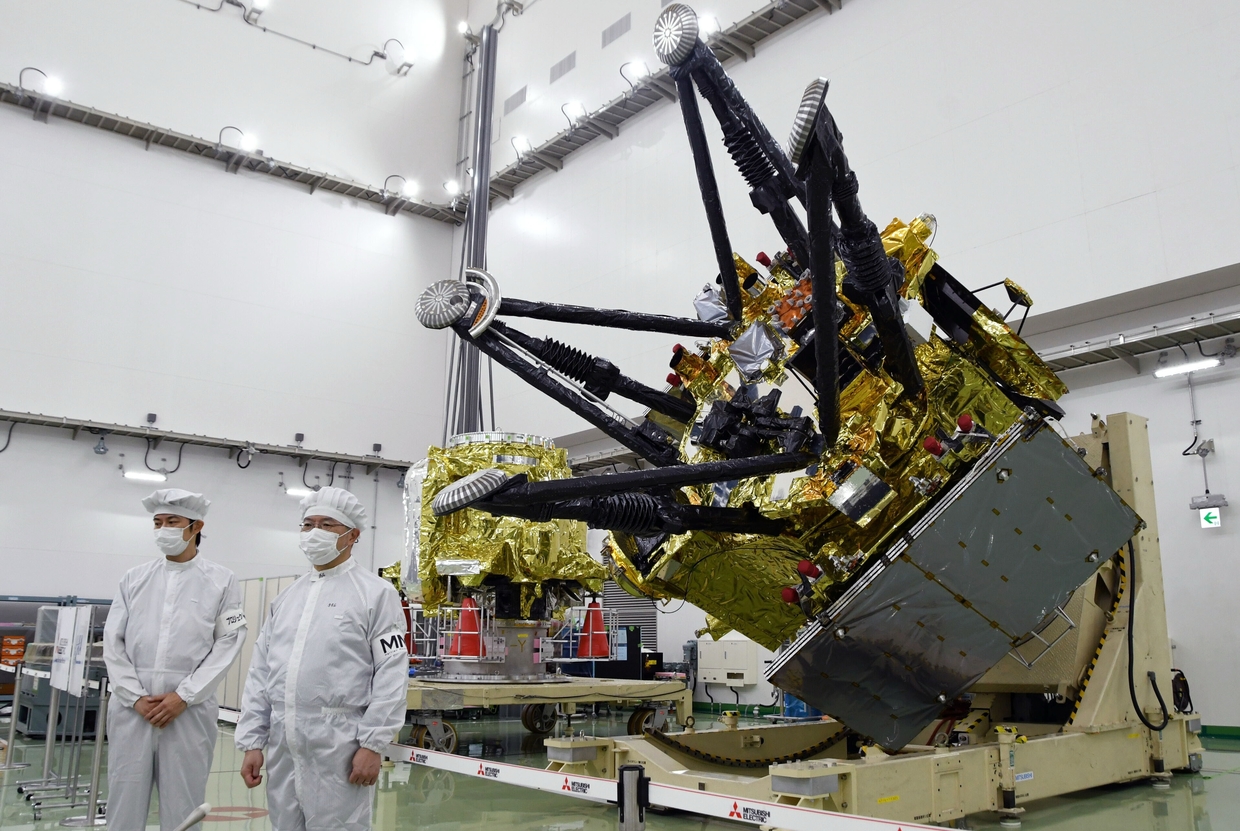
Landing on Phobos presents a major technical challenge. The moon measures just 27 kilometers across its longest dimension, and its gravitational pull is too weak for conventional close-orbit operations. Instead, MMX will synchronize its orbit around Mars with that of Phobos, effectively becoming a “quasi-satellite” of the moon.
Scientists hope the samples will help establish whether Phobos formed from debris thrown into orbit by a massive impact on Mars or is an asteroid captured by the planet’s gravity.
Martian soil and rock samples have been collected and analyzed on the planet’s surface by several previous missions. NASA’s Perseverance rover has also preserved samples for eventual return to Earth, but the retrieval mission planned jointly with the European Space Agency lost its funding earlier this year.
China’s Tianwen-3 mission could return samples collected directly from Mars to Earth as early as 2031.